
AGA Report Puts Alternative Gaming Tax Gap in the Spotlight
Commercial Gaming Growth Raises New Questions for Sweepstakes and Skill Gaming Models

The American Gaming Association reported that U.S. commercial gaming revenue reached $20.09 billion in Q1 2026, up 6.0% year over year.
The regulated gaming generated $4.67 billion in state gaming taxes, but noted that tax revenue could be higher because skill machines, sweepstakes casino sites, and sports betting through prediction market platforms do not pay state gaming taxes.
The tracker adds another layer to the growing policy debate around alternative gaming models, especially those that operate outside traditional casino or sportsbook licensing systems.
What Happened?
The American Gaming Association released its latest Commercial Gaming Revenue Tracker on May 26, 2026.
The tracker shows continued growth across the regulated U.S. gaming market. Commercial gaming revenue reached $20.09 billion in the first quarter of 2026, a 6.0% increase from the same period last year.
Traditional casino gaming generated $12.48 billion, while sports betting produced $4.27 billion in revenue. Online casino gaming, or iGaming, reached $3.04 billion, up 20.7% year over year.
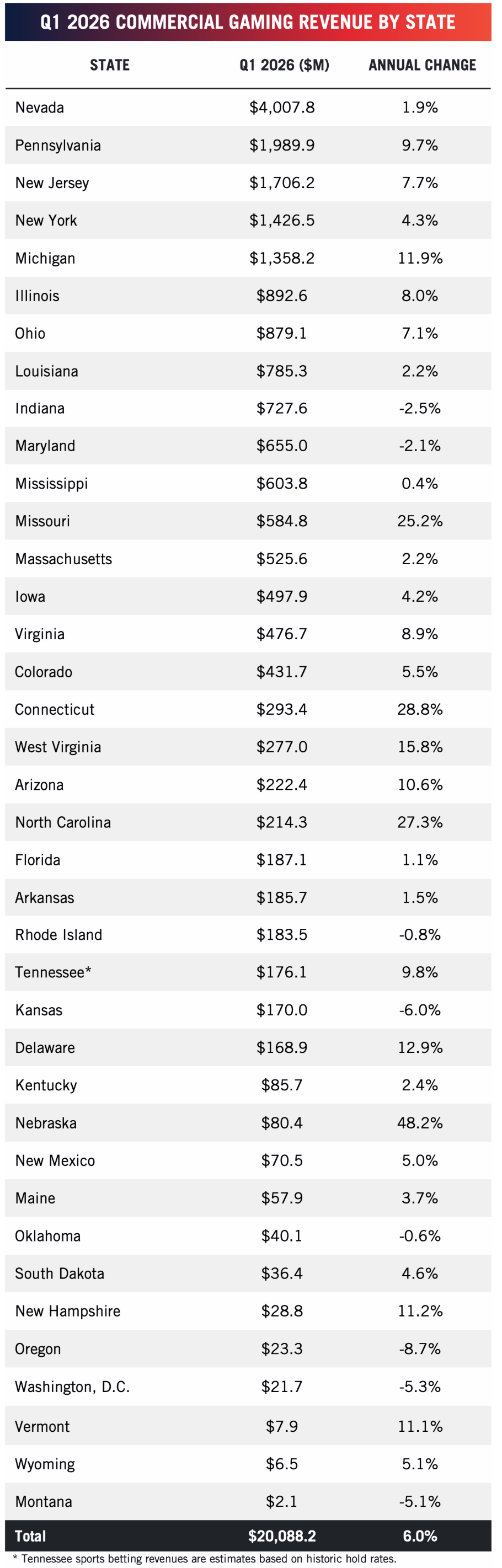
The most important line for alternative gaming came in the tax section. The AGA said regulated gaming generated $4.67 billion in state gaming tax revenue during Q1, but added that the figure could be significantly higher. The group pointed to operators of skill machines, “sweepstakes casino” sites, and companies offering sports bets through prediction market platforms, saying those models do not pay state gaming taxes.
Why This Matters
The lawmakers and regulators have another argument to use when reviewing alternative gaming models.
For years, the debate around sweepstakes casinos, skill games, social sportsbooks, and prediction markets has focused on whether these products legally qualify as gambling. The AGA tracker adds a different issue: whether these models create a tax gap compared with licensed casinos and sportsbooks.
That matters because regulated gaming operators are licensed, taxed, and subject to compliance rules. Alternative gaming models often operate under different legal theories, such as sweepstakes promotions, social gaming, skill-based play, or event contracts.
The AGA’s framing may increase pressure on states to examine whether these products should face closer oversight, especially when they resemble gambling products from a consumer perspective.
Regulatory Background
Gaming regulation in the U.S. is mostly handled at the state level. Licensed casinos, sportsbooks, and iGaming operators usually need state approval before offering real-money gambling products.
Those operators also pay gaming taxes and follow rules covering age verification, responsible gambling, advertising, anti-money laundering controls, and player protection. The Alternative gaming models are different.
Sweepstakes casinos usually rely on dual-currency systems, where one currency is used for entertainment play, and another may be used for prize redemption. Social casinos generally focus on entertainment-only play. Social sportsbooks may use free-to-play or sweepstakes-style sports prediction formats. Prediction markets may offer sports-related event contracts under a separate legal framework.
The problem for regulators is that these categories can overlap. A product may not call itself a casino or sportsbook, but still look and feel similar to one. That is where the tax and licensing debate begins.
Regulatory Risk Meter
| Factor | Assessment |
|---|---|
| Enforcement Risk | Medium |
| Litigation Risk | Medium |
| Operator Impact | Medium |
| Player Impact | Low to Medium |
The risk level is medium because the AGA report does not create a new law or enforcement action. However, it gives regulators and lawmakers a clear policy argument around tax revenue.
The player impact is lower for now because the tracker does not immediately change access to any platform. That could change if states respond with new restrictions, lawsuits, or enforcement actions.
Industry Impact
The AGA tracker may not change the law directly, but it gives the regulated gaming industry a clear talking point around taxation, licensing, and market fairness. For alternative gaming businesses, the bigger concern is how this tax-gap argument could influence future state reviews, operator decisions, and affiliate partnerships.
For Operators
Alternative gaming operators may face more questions about how their products are structured, promoted, and taxed.
Sweepstakes casino operators may need to show that their free-entry options, promotional currency rules, and prize redemption systems are clearly explained. Skill gaming platforms may face renewed questions about whether outcomes are truly based on skill. Prediction market platforms offering sports-related contracts may continue to face scrutiny from states that view those products as sports betting.
For Players
Players should not expect immediate changes from the AGA report alone. It is a revenue tracker, not a new regulation. However, if states act on these concerns, players could see changes in state availability, account verification, redemption rules, or platform access.
For Affiliates and Partners
Affiliates and media partners may need to be more careful when covering sweepstakes casinos, social sportsbooks, prediction markets, and similar models. State availability, redemption terms, age restrictions, and promotional language should be checked regularly. If regulators become more aggressive, outdated content could create compliance risk.
Compliance Questions Raised
The report raises several unresolved questions for the industry.
- Should sweepstakes casino operators face gaming taxes if their products include prize redemption?
- Should sports event contracts offered through prediction markets be treated differently from licensed sports betting?
- How should regulators separate entertainment-only social casinos from sweepstakes platforms with redeemable prizes?
- Should affiliates face stricter rules when promoting alternative gaming products?
- These questions are likely to become more important as regulated operators continue to highlight tax and licensing differences.
What Happens Next?

The AGA report is unlikely to trigger immediate action on its own. Its bigger role is as supporting evidence in future policy debates. State lawmakers may use similar tax arguments when considering bills that target sweepstakes casinos, skill games, or sports prediction products. Regulators may also use this framing when reviewing whether certain platforms should be licensed, restricted, or investigated.
Operators may respond by tightening compliance language, adding clearer state-level restrictions, improving responsible-play tools, or adjusting promotional models.
The next major developments are likely to come from state legislation, attorney general actions, gaming regulator guidance, or lawsuits involving specific operators.
Stakester Analysis
The AGA tracker shows that regulated gaming is still growing, but the more important regulatory signal is the tax gap argument. For alternative gaming, this matters because tax revenue is often what turns a legal gray area into a policy priority. States may be more likely to act when they believe unlicensed or lightly regulated products are competing with taxed gaming operators.
The report does not decide whether sweepstakes casinos, skill games, social sportsbooks, or prediction markets are legal or illegal. But it does show that these models are now part of a broader conversation about gaming revenue, taxation, and regulatory fairness.
Sources
American Gaming Association:
Commercial Gaming Revenue Tracker
Stakester Newsletter
Be the first to find out when a sweepstakes casino launches and receive exclusive offers directly in your mailbox.
About the author
Angelica
Angelica writes about iGaming and sports trend topics, sweepstakes regulation, market shifts, and player-focused developments across the online gaming world. Her work blends clear reporting with approachable context, making complex updates easier to understand.